
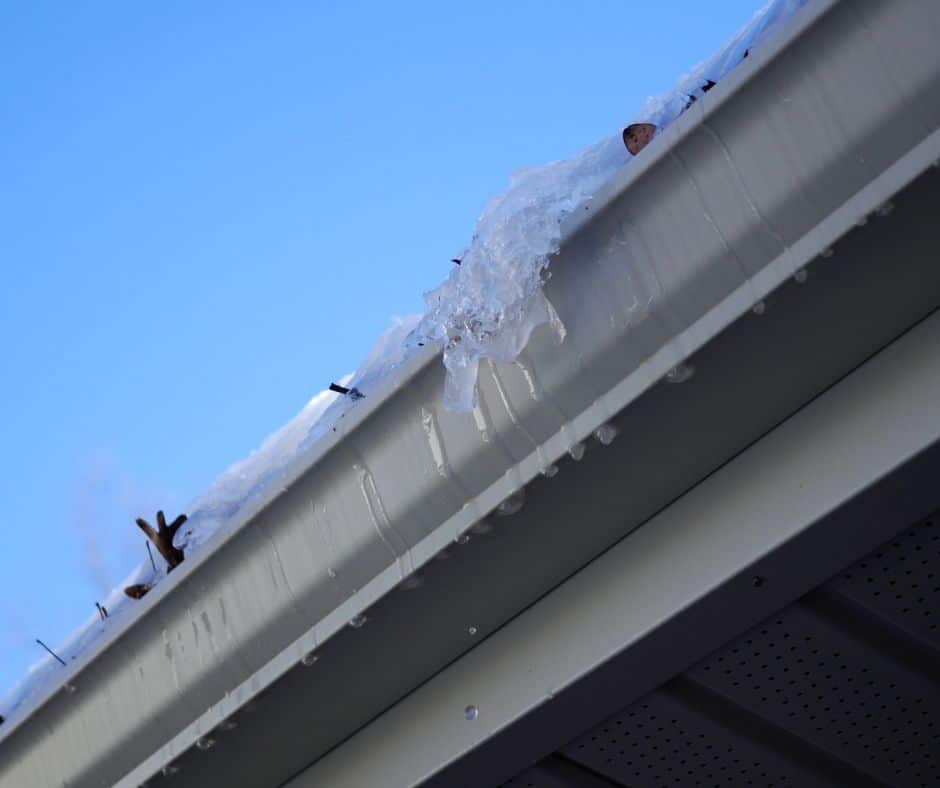
If you’ve lived in mid-Michigan for more than one winter, you’ve probably seen them — those thick ridges of ice hanging off the edge of someone’s roof, with icicles dangling below. They look kind of picturesque, honestly. But they’re one of the more expensive roofing problems we deal with every January and February, and the damage they cause often doesn’t show up until spring.
Here’s what an ice dam actually is, why it happens, and what you can do before the snow hits to keep your roof from becoming a problem.
What Causes an Ice Dam
Ice dams form when heat escapes from your living space into the attic, warms the roof deck, and melts the snow sitting on top of your roof. That snowmelt runs down toward the eaves, where the roof overhangs the exterior wall — and that part of the roof is colder because it’s not above heated space. The water refreezes there, building up into a ridge of ice.
Once that ice dam is established, subsequent snowmelt has nowhere to go. It backs up behind the dam and sits on your roof. Over time, it works its way under the shingles, under the underlayment, and eventually into your attic, your insulation, and your ceilings.
In Lansing, we get the perfect conditions for this every winter: fluctuating temperatures, heavy snow loads, and a lot of older homes with less-than-ideal attic insulation and ventilation.
The Real Cause Is Usually Insulation and Ventilation
A lot of homeowners think ice dams are a roofing problem, but they’re really more of an insulation and ventilation problem. The goal is to keep your entire roof deck cold and uniform in temperature, so there’s no warm zone in the middle that melts snow while the edges stay frozen.
That means making sure your attic is well-insulated (so heat from your living space stays in your living space), and that your attic has adequate ventilation (so cold outside air can circulate under the roof deck and keep it at a consistent temperature).
If your attic insulation is inadequate, which is common in homes built before the 1990s, adding more is one of the most effective things you can do to prevent ice dams. It’ll also lower your heating bills, so it pays for itself over time.
Ice and Water Shield: Your Last Line of Defense
Even with good insulation and ventilation, you still want a proper ice and water shield membrane installed along the eaves of your roof. This is a self-adhering underlayment that seals around nail penetrations and prevents water from getting into the roof deck, even if it backs up behind an ice dam.
Building code in Michigan requires it along the eaves, but older roofs may have had it installed incorrectly, or not at all. If you’re having your roof replaced, make sure your contractor is using it. At Capital Roofing, it’s standard practice on every job.
What About Roof Rakes and Heat Cables?
Roof rakes — those long-handled tools for pulling snow off your eaves, are a legitimate short-term solution if you’re already dealing with ice dams and need to reduce the load on your roof. But they’re not a substitute for fixing the underlying problem, and improper use can damage your shingles.
Heat cables installed along the eaves can also help in problem areas, but they’re expensive to run and don’t address the root cause.
The better investment is to address your attic’s insulation and ventilation before next winter and have your roof inspected to ensure you have proper ice and water protection.
Ready to schedule your free roof inspection? Call or text Capital Roofing at (517) 896-5872 or visit capitalroofingpro.com. Serving Lansing, East Lansing, Grand Ledge, St. Johns, Okemos, and communities across Greater Lansing.